How to Translate Medical Documents Safely and Accurately
By PageTranslate Team · · 7 min read
Here is how to translate medical documents safely. Sort each one by what a mistake would cost, use machine translation only as a draft, and have a qualified human check anything a patient will act on. In the US, if a hospital or insurer uses machine translation on critical text, federal rules require that review.
The reason is plain. In a 2019 study of discharge instructions run through Google Translate, a line telling a patient to hold a kidney medicine came back as an instruction to keep taking it, and clinicians rated the error as potentially life-threatening. One sentence. This guide is general information, not legal or medical advice.
Drafts for PDF, Word and EPUB files. Exact price before you pay. Not a certified translation.
Sort the document by risk first
Not every medical document needs the same care. These tiers are my own sorting and carry no legal weight.
| Risk | Typical documents | Machine translation | Review |
|---|---|---|---|
| Lower | Clinic hours, visitor rules, general health leaflets | Fine as a first draft | Read it through, and have someone fluent check it before you publish it |
| Medium | Lab reports, insurance letters, appointment notices | Good for understanding what it says | Confirm with the sender before you rely on it |
| High | Consent forms, discharge and medication instructions, prescriptions, records used for care decisions | A draft at most | A qualified human translator, plus a clinician where doses or diagnoses appear |
If you can't tell which row a document belongs in, use the higher one.
What the US rule says
The rule is 45 CFR 92.201(c)(3), part of the Section 1557 regulations. It says that when a covered entity uses machine translation on text that is critical to a person with limited English proficiency, where accuracy is essential, or where the source is complex, non-literal or technical, a qualified human translator must review the translation. "Critical" is not defined.
A covered entity is a recipient of federal financial assistance, an HHS program or an Affordable Care Act marketplace entity, which includes many hospitals, clinics and insurers. A patient translating their own discharge papers is in a different position, and I found no HHS wording that addresses it. The definition of a qualified translator in 45 CFR 92.4 asks for proficiency in English and another written language, accuracy, impartiality and confidentiality. It sets no certification.
Two nuances. HHS's December 2024 letter on language access allows machine translation in an urgent case where no qualified translator can check it first, with review "as soon as practicable". And a federal court in October 2025 vacated parts of the 2024 rule, but HHS's June 2026 notice says the vacatur covers only gender-identity provisions and "the other provisions of the 2024 Rule remain in force". I could not open HHS's own Section 1557 page on October 2,, so read the current eCFR text before you rely on this.
Certified is a different question
In the United States, anyone can certify a translation, according to the American Translators Association, and the receiving office decides what it accepts. USCIS asks for the translator's signed certification of completeness and competence. A hospital, insurer, court or embassy may ask for something else, and I haven't verified any of their rules. So a machine draft plus a review is not a certified translation until a person puts their name to it.
What the evidence says about machine translation
The 2019 study, by Khoong and colleagues in JAMA Internal Medicine, checked 647 discharge sentences. Spanish came out 92 percent accurate and Chinese 81 percent. About 2 percent of Spanish and 8 percent of Chinese sentences could have caused clinically significant harm, and for Chinese medication instructions the figure was 16 percent.
A 2026 BMJ Quality and Safety study of GPT on 316 sentences did better. Sentence accuracy was 97 percent in Spanish, 95 in Chinese and 89 in Russian. But a set of instructions has several sentences, and one wrong one is enough, and 16, 24 and 56 percent of the sets had at least one inaccuracy.
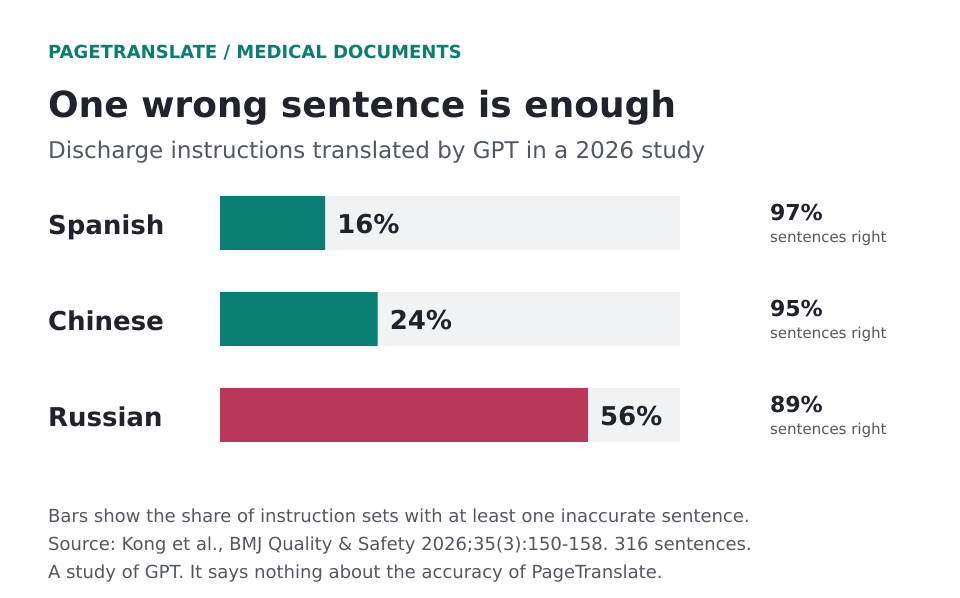
Share of instruction sets with at least one inaccurate sentence, from the 2026 BMJ Quality and Safety study of GPT (not PageTranslate).
The authors support machine translation for low-stakes written messages in Spanish and ask for caution and professional oversight elsewhere. A 2024 Pediatrics study found Haitian Creole worse. ChatGPT-4 and Google Translate had potentially significant errors in 23 to 33 percent of cases, against 8.3 percent for professionals. These are studies of other tools. They tell you nothing about the accuracy of ours.
A safer workflow
- Classify it using the table above, before anything is uploaded.
- Prepare the source. Use the cleanest file you have. For a scan, read the section on scans below.
- Translate the whole document in context, so a drug name is translated the same way throughout. In my own DOCX test on October 2, the table cells came back untranslated, and so did the header and footer. The product's DOCX page says to expect that. Lab results live in tables. Check them by hand.
- Have a qualified person review it against the source. For clinical text, add a clinician to check doses and units.
- Write down what you did. Who translated, who reviewed, which tool, which version of the source and the date. If a regulator or a family member asks later, you will have an answer.
Keep original next to the translation, always. The post-editing guide describes the review pass in more detail, and translation quality explains how to score a sample.
Terms that need extra care
Drug names differ by country (acetaminophen in the US is paracetamol in many other places). Doses and units are where a slip can hurt, so compare every number with the source, including dates, because 03/04 is March 4 to an American and April 3 to most Europeans.
Abbreviations deserve their own look. The Joint Commission's "Do Not Use" list and the Institute for Safe Medication Practices keep lists of error-prone ones, and a translator can move one from a language where it is understood into a language where it means nothing, or something else.
| Abbreviation | Risk, per ISMP and the Joint Commission | Write it out as |
|---|---|---|
| U | Mistaken as zero or 4, so 4U can be read as 40 | unit |
| IU | Mistaken as IV or 10 | international unit |
| QD | Mistaken as QID | daily |
| MS, MSO4, MgSO4 | Mistaken for one another | the full drug name |
| µg | Mistaken as mg | mcg |
Allergies are the other category I would never leave to chance. "No known allergies" and a list of allergens should be read against the source by a person.
Consent forms and patient communication
A consent form is the document where understanding is the whole point. For research, 21 CFR 50.20 and 45 CFR 46.116(a)(3) require the information to be in language the subject can understand. When a full form isn't available in the person's language, 21 CFR 50.27(b)(2) and 45 CFR 46.117(b)(2) describe a short form, with an oral presentation, a witness and an approved written summary. Both cover research consent. Consent for ordinary treatment follows state law and hospital policy, which I haven't surveyed.
Interpreters matter here too. A translated form does not replace a conversation, and the interpreter and translator post explains who does which job.
Scanned medical PDFs
Many records arrive as scans or faxes. PageTranslate reads scanned PDFs in English, French, German, Italian, Portuguese and Spanish. In my own OCR test, a Spanish page read with the English setting kept 85 percent of its words and 4 of 74 accented ones, and the correct setting kept 99.6 percent and 73 of 74. Accents change drug names. If you want a searchable copy of your own first, how to make a PDF file searchable and batch OCR PDF cover it, and the PDF translator page lists what comes back.
Handwriting, rubber stamps and faint print are the likeliest to fail. Compare every number with the page.
Privacy before you upload
HIPAA applies to covered entities and the vendors who handle protected health information for them. HHS says a covered entity may disclose it to a business associate only with a written agreement. PageTranslate's security page describes encryption and retention, and the word HIPAA does not appear on it or on the privacy page. So I can't tell you the service is HIPAA-compliant, and you shouldn't assume it. If you work for a hospital, clinic or insurer, ask your compliance team before any patient record goes into any online tool.
What PageTranslate does and doesn't do
It translates the text in PDF, Word and EPUB files into 70 languages, returns the same format, and shows an exact price before you pay (see the cost FAQ). It does not produce certified translations. It has no glossary upload, no medical term list, no reviewer workflow and no HIPAA claim. And in DOCX files, tables, headers and footers are left alone. The DOCX translator page says so, and so do the files I got back.
For anything a patient will act on, the American Translators Association's statement on AI gives the right frame. It supports AI for predictable, low-risk content and drafts for expert revision. In healthcare, it says, nobody can afford AI-generated mistranslations. When the stakes are high, get quotes from qualified translators and compare them with how to compare translation quotes. If you only need a first draft for your own understanding, machine vs human translation lays out the trade.