Difference Between Interpreter and Translator (Simple Guide)
By PageTranslate Team · · 4 min read
The difference between interpreter and translator is the medium. Translators work on written text and have hours or days to research and revise it, while interpreters carry speech or sign language into another language as it happens, with no second draft.
That gap decides who you hire. Being bilingual is not enough for either job. A fine translator can freeze on a live call, and a sharp conference interpreter may never have produced a document you could file. The US Bureau of Labor Statistics counts the two as one occupation, with a median pay of $60,170 as of May 2025, which hides how different they are.
Written files only. PageTranslate does no interpreting.
The short answer, written versus spoken
| Translator | Interpreter | |
|---|---|---|
| Works with | Written text | Speech or sign language |
| Timing | Later, with time to research and revise | Now, in real time |
| Delivers | A finished document or asset | Live communication |
| Usual places | Desks, agencies, publishers, software teams | Hospitals, courtrooms, conferences, meetings |
Both jobs move meaning between languages and cultures, and both depend on knowing the subject. Training, tools and pressure are what differ.
What a translator does
A translator converts documents, websites, books, contracts, subtitles and product copy. The target is meaning, tone, terminology and cultural context, and a literal word swap usually misses all four.
Most translators work from one source language into one strong target language, usually their native one. The American Translators Association's certification exam is directional for the same reason, testing into or from English, and never both at once. The time to look things up, build a glossary and have a second linguist check the draft is what separates a translator's workday from an interpreter's.
What an interpreter does
An interpreter converts live speech, in person, by phone or by video, in settings such as medical appointments, court hearings, conferences, business meetings and community services. ISO 18841 and NAJIT describe three modes.
- Consecutive. The speaker pauses and the interpreter delivers the message afterwards. AIIC describes segments of roughly five to ten minutes.
- Simultaneous. The interpreter speaks while the speaker is still going. This is the booth-and-headset work of conferences, and AIIC's standards call for at least two interpreters per language and per booth.
- Sight translation, a close cousin. The interpreter reads a written text aloud in the other language, as when a court form needs explaining on the spot.
There is also chuchotage, simultaneous interpreting done in a whisper for one or two listeners with no equipment.
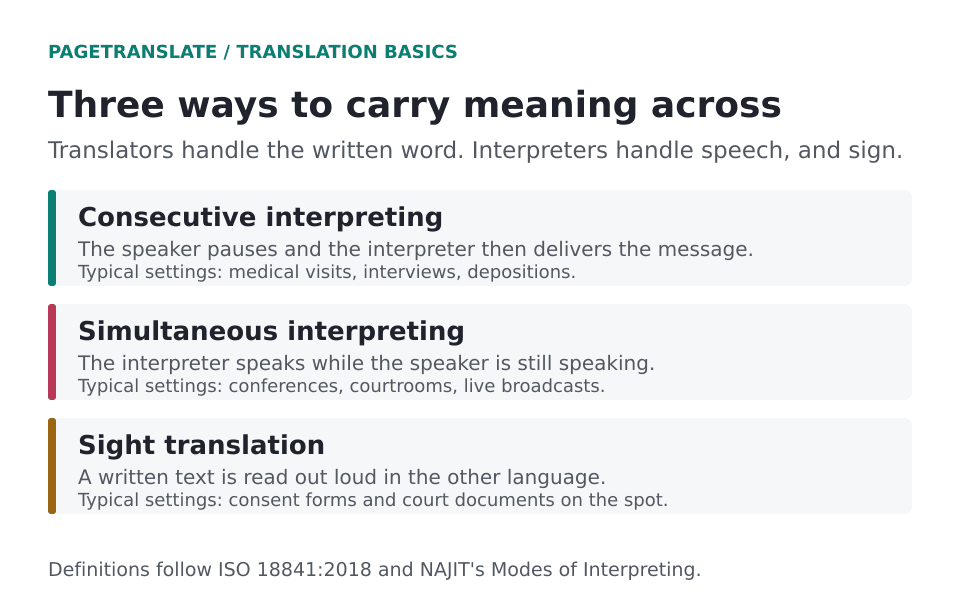
The three interpreting modes.
Translator vs interpreter side by side
| Factor | Translator | Interpreter |
|---|---|---|
| Direction | Usually one direction, into a native language | Often both directions in the same session |
| Pace | Hours or days per text, with revision | Seconds, with no revision |
| Preparation | Research, glossaries, reference files | Terminology lists, briefings, speaker notes |
| Main skills | Writing, research, terminology, consistency | Listening, memory, composure, quick judgment |
| Tools | CAT software, translation memory, post-editing | Remote interpreting platforms, booths, glossaries |
| Credentials on offer | ATA certification for written work | Court and healthcare credentials, varying by country and state |
When you need a translator
Contracts, manuals, websites, books, marketing campaigns, academic papers and app text all want a translator. So does any text that has to stay accurate and consistent for years, which is where translation quality and a written style guide start to matter.
If you are buying the work, how to compare translation quotes covers what a quote should and shouldn't leave out.
When you need an interpreter
You need one wherever people who share no language are talking right now. Legal, medical, diplomatic and conference settings are the usual ones, and immediacy is the point.
Many interpreters specialize, and professional codes of ethics and confidentiality come with job. The credential depends on the setting. The US federal court exam covers Spanish and English only, with other languages handled through qualified or skilled categories. For healthcare, CCHI and NBCMI run certification programs, and state courts have their own.
Can someone be both?
Yes, and plenty do,, but the two professions are distinct. Subject knowledge, training and practice matter more than the second language alone.
When you check credentials, start with the setting and ask what it needs. No single certificate is universally required. The Bureau of Labor Statistics says general certification typically is not required, and certificates differ in scope, since the ATA exam covers translation only. For immigration, USCIS wants a full English translation with the translator's signed statement of competence and accuracy, and nothing there says "certified translator" in the sense of an exam. Ask for samples, references and subject experience, and for a short paid test where the stakes justify it.
How translation tools fit in
Translators commonly use CAT tools, translation memories, glossaries and machine translation with human post-editing (ISO 18587 covers the last of those). Interpreters lean on different support, such as remote interpreting platforms (ISO/PAS 24019 covers simultaneous interpreting delivery platforms) and a glossary prepared before the event.
PageTranslate sits on the written side. It translates whole PDF, Word and EPUB files and returns the same format, with the price shown before you pay. It doesn't interpret, and it isn't a certified or sworn translation. There is no glossary upload, translation memory or reviewer workflow either, so treat the output as a draft, as the guides on machine translation post-editing and machine translation vs human translation explain, and the limits of Google Translate are worth knowing too. For books there is the book translation page, and the cost FAQ shows how the price is worked out.