Machine Translation Post Editing (MTPE): A Practical Guide for Books
By PageTranslate Team · · 7 min read
Machine translation post editing is what you're doing the moment you fix an AI draft instead of starting from a blank page. Most people do it badly because nobody told them where to stop.
Quick answer. A machine translates first. A human then corrects the output, either lightly (so it's understandable) or fully (so it reads like a human translation). For a book people will pay for, plan on full post-editing, chapter by chapter, with a names list open next to you.
This guide is for authors and small presses, or really anyone holding a DOCX or EPUB that has to exist in another language by some deadline. If you only need to understand a foreign email, skip it.
Exact price before you pay · 3,000 free starter words with a verified account · 7-day re-run or refund on jobs up to 50,000 words
Light and full post-editing are two different jobs
Translators split MTPE into two levels, and the split matters more than any tool you pick.
Light post-editing gets the text to "good enough." The TAUS/CNGL guidelines (the ones most agencies still quote) tell editors to use as much of the raw MT output as possible and to skip changes that are purely stylistic. You fix wrong meanings. You leave clunky-but-correct sentences alone.
Full post-editing aims for text you couldn't tell apart from a human translation. Grammar and terminology get checked. So does the formatting, which people forget. ISO 18587:2017 is the international standard for this, and it only sets requirements for full post-editing. Light post-editing sits outside its requirements entirely, which tells you something about how the industry sees it.
For fiction, light post-editing is basically never enough. Readers forgive a lot. They won't forgive dialogue that sounds like a user manual.
Speed data from real studies
The numbers worth trusting come from a handful of controlled studies, and they're smaller than what vendor blogs throw around.
The most useful study for book people is still Toral, Wieling and Way (2018), because they used an actual novel (Brandon Sanderson's Warbreaker, English to Catalan). Translators managed 503 words an hour from scratch, 594 post-editing older statistical MT and 685 post-editing neural MT. That's roughly 36% faster with the better engine. Keystrokes dropped by 23%.
Industry case studies report bigger jumps. A 2010 Autodesk test (Plitt and Masselot) measured a 74% average throughput gain, with individual translators ranging from 20% to 131%. That was software documentation, though. Short, repetitive sentences are the dream case for MT, and your novel is not that.
Then there's the result I'd tape to the monitor. In a 2025 experiment on Margaret Atwood's Oryx and Crake (Castaldo et al.), post-editing GPT-4 output took 64.3 minutes. Translating by hand took 115.7. But post-editing GPT-3.5 output took 119.7 minutes, slower than no machine at all. The study only had four translators, so treat the exact figures loosely, but the direction matches what editors complain about on forums. A weak draft costs you more than it saves because you keep second-guessing it.
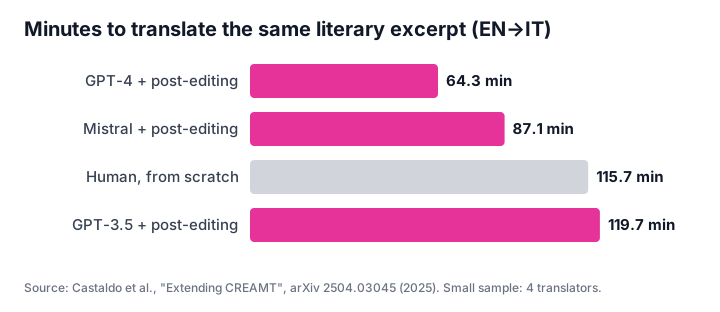
Minutes to translate the same literary excerpt, EN→IT. Data from Castaldo et al., 2025 (4 translators).
Academic reviews summarized on Wikipedia's post-editing page land in the same place. Controlled studies find something like 0–20% time savings under real working conditions, while industry reports claim around 40%. I lean toward the academic number for literary text, at least for most language pairs.
A post-editing workflow for a book-length file
This is the order that's worked for me on long files. Adjust it, but dont skip step two.
- Clean the source first. Fix typos and broken paragraphs. Then make sure chapter headings use real heading styles, because the draft inherits whatever structure you give it. Garbage in the source becomes confident garbage in the draft.
- Build a names and terms sheet before you read a single translated line. Characters and places go in, plus the one magic-system term that shows up 400 times. I keep mine in a two-column spreadsheet (source, target) pinned to the left half of the screen. On one fantasy manuscript the sheet hit 180 rows by chapter nine, most of them spellings of a single river.
- Run the machine translation on the whole file at once so the engine sees consistent context and you get one file back. Pasting chapters into a chat window one by one loses that.
- Read chapter one against the source. Slowly. This is where you learn the engine's habits. Maybe it flattens formal and informal "you." Maybe it translates a surname that should stay put.
- Fix the recurring problems globally with find-and-replace, then do the sentence-level edit.
- Full post-edit every chapter. Dialogue first if you're short on time; that's where machine output sounds most off.
- Formatting QA. Look for italics that vanished and scene breaks that collapsed. Footnote numbers too
- A cold read by a native speaker who has never seen the source. They're checking whether it reads like a book.
Somewhere around step six you'll notice the machine was more consistent than you are by late evening. That's normal. Check your own edits against the names sheet before you close the file for the night.
What to fix, and what to leave alone
Over-editing is how MTPE projects blow their budget. Every editor has a pet phrasing, and rewriting a correct sentence into your preferred correct sentence feels productive while adding zero value.
Fix these.
- Meaning errors. Always.
- Names and terms that drift from the sheet.
- Register. If the engine made a grumpy sea captain sound like a customer service rep, that's a meaning problem even when every word is technically right.
- Idioms translated literally (the classic "it's raining cats and dogs" disaster, though modern engines rarely do that one anymore).
- Anything a reader would stumble on twice.
Leave these alone unless you're doing a full literary polish.
- Sentence order you'd have chosen differently.
- Synonyms. "Said" versus "replied" is not worth your hour.
Researchers found that post-editing tends reduce creativity in literary translation compared with human-only work, because the draft anchors you. So for the ten or so passages that carry the book (the opening page, the big reveal, the last paragraph), I'd translate them fresh from the source and ignore the machine entirely.
Tools that make MTPE easier
Solo authors don't need a translation management system. A word processor with Track Changes gets you surprisingly far, and a DOCX output is the easiest thing in the world to post-edit because every change is visible and reversible.
- DOCX. Word or LibreOffice with Track Changes on. Send the tracked file to your bilingual reviewer so they only look at what changed.
- EPUB. Sigil or Calibre's built-in editor. Both let you edit chapter files directly without breaking the table of contents.
- CAT tools like memoQ or Trados are what agencies use (Smartcat if you want it in a browser), with translation memory and QA checks built in. They are overkill for one novel and very good for a series.
Where PageTranslate fits is the step three draft. It translates the whole book file in one job and hands it back in the format you uploaded, so you post-edit inside the actual book file instead of pasting text back into a layout. Character and place names are kept consistent across chapters. It doesn't take a glossary upload yet, so the names sheet from step two is still your job. And to be clear about what it is, it's AI translation, not certified and not edited by a human. The post-editing is the part you (or your translator) bring.
What MTPE costs
If you hire someone, don't assume post-editing is cheap. A 2025 GTS survey of 212 freelance translators found about half give no discount at all for MTPE work. Among those who do, 10 to 30 percent off their normal rate was the common range. And a lot of experienced literary translators simply decline post-editing jobs, which is their right (it's a different, often less satisfying kind of work).
Adoption keeps climbing anyway. Nimdzi reported MTPE use among language service providers rising from 26% in 2022 to about 46% in 2024.
The machine side is the cheap part. PageTranslate's quote page shows the exact price for your file before you pay (list prices started at $1.20 per 1,000 words as of September 2026), and this cost breakdown walks through a full novel. Budget most of your money for the human pass.
Mistakes that show up in almost every first MTPE project
- Editing without the source open.
- Trusting fluent sentences. Modern MT is extremely fluent, and fluent-but-wrong is harder to spot than broken-and-wrong. Check the numbers. Check negations twice, since a dropped "not" reads perfectly fine.
- Letting three different spellings of a character's name survive to the final file.
- Skipping the formatting pass, then finding out on a reader's phone that every italic thought turned into plain text..
- Paying for full post-editing and getting light, because nobody wrote down which one they meant.
That last one is avoidable with one sentence in the brief. Name the quality level (the TAUS terms work fine) and give an example paragraph of what "done" looks like.
Related reading
- Machine translation vs human translation, for deciding whether MTPE is right for your project at all
- Google Translate is bad at books, on why the draft engine matters
- DeepL alternatives for whole books and formatted files
- AI novel translator
Post-edit a real chapter before you commit to the whole book.