Machine Translation vs Human Translation: What a Book Actually Needs in 2026
By PageTranslate Team · · 6 min read
Machine translation vs human translation used to be an easy call for books. It isn't anymore, and the 2024–2025 research is why.
Quick answer. Human translation still produces the better book, especially for voice and dialogue. Machine translation is now good enough to be a strong first draft at roughly 1% of the cost. For most self-published and backlist titles, the sensible middle is an AI draft followed by a bilingual human edit.
If you're an author or a small publisher weighing a translated edition, this is for you. The numbers below come from studies and surveys, with links, so you can check them.
Exact price before you pay · 3,000 free starter words · 7-day re-run or refund on jobs up to 50,000 words
The two options in plain numbers
I'll use a 90,000-word novel because that's a normal adult fiction length and it makes the maths easy.
| Human literary translator | Machine translation (AI draft) | AI draft + human post-edit | |
|---|---|---|---|
| Typical cost | ~$11,700 at $0.13/word (Authors Guild 2022 survey) | About $122 on PageTranslate's pay-as-you-go list price (Sept 2026) | Draft cost plus editor fee, often 10–30% below full rate or no discount at all |
| Time | 30–45 working days at 2,000–3,000 words/day (Slator) | Under a day | Days to weeks |
| Voice and style | Best | Flatter, more literal | Close to human if the editor is good |
| Consistency across chapters | Depends on the translator's notes | Good for names in a single job | Good |
| Risk of silent errors | Low | Real (omissions, wrong subject) | Low if the editor reads the source |
The Authors Guild range runs from about $0.01 up past $0.40 per word, so treat $0.13 as a middle, not a quote. And that translator, doing four or five books a year at that rate, is making somewhere around $50,000. Nobody's getting rich here.
How machine translation got good
Quick history, because it explains the failure modes you'll still see.
The Georgetown-IBM demo in January 1954 translated Russian sentences with 250 words and six grammar rules, and made the front page of the New York Times. Twelve years later the US government's ALPAC report called machine translation slower than human work and less accurate too. Funding basically dried up.
Statistical systems took over in the 1990s and 2000s. Then in September 2016 Google switched to neural machine translation and reported cutting errors by 55–85% on several language pairs. The Transformer architecture followed in 2017, and by 2024 the big engines were running on large language models.
Each generation fixed the previous one's worst habit. Rule-based systems were rigid. Statistical ones produced word salad. Neural and LLM systems write smooth, confident sentences, which is great untill the smooth sentence is wrong.
What the research says about quality now
This is where most articles on this topic are stuck in 2023.
At the WMT conference (the main yearly shared task for MT research), human reference translations landed in the top cluster for only 7 of 11 language pairs in 2024. In 2025 it was 6 of 15, and Gemini 2.5 Pro sat in the top cluster for 14. The report even called literary text the "easiest" domain. There's a catch, though, and it's a big one. Those were short excerpts judged against vendor-produced references, which is a very different test from a published translator working on a whole novel.
When researchers compare against real published translations, humans pull ahead. A NAACL 2025 paper found published human translations consistently beat LLM output, which came out more literal and less varied. Earlier work by Läubli and colleagues showed raters prefer human translation more clearly when they judge whole documents instead of isolated sentences. That matches my own reading experience. Page one of a machine-translated novel looks fine; by chapter four you notice every character talks the same way.
A 2026 preprint had 15 readers compare excerpts from 15 novels (Ferstler et al., not yet peer reviewed). Readers preferred the human version in 19 of 30 excerpts, but they only guessed which one was human 17 times out of 30. So the gap is real and smaller than translators would like.
Where machines still slip
- Omissions. A 2023 study of GPT-3.5 paragraph translation found critical errors "still abound," including dropped content. A missing sentence doesn't look missing.
- Wrong subject in long sentences, especially in languages that drop pronouns.
- Register. Formal and informal "you" flattened into one.
- Puns and wordplay. Mostly lost.
- Invented words in fantasy and sci-fi, which some engines "correct" into real words (I once watched a draft turn a made-up city called Vessmere into "Vessel Sea" in exactly half the chapters, which was somehow worse than getting it wrong everywhere).
When machine translation is enough
Sometimes a draft is the whole job.
Reading a foreign book for yourself is one case. Checking what a foreign-language contract says before paying for a certified translation is another. So is testing whether there's any interest in a translated edition before you spend five figures on it.
Backlist titles are the interesting middle ground. If you have eight books earning nothing in Spanish or German, a post-edited AI translation can get them out for a fraction of the human cost. Plenty of indie authors on the KDP forums are doing exactly that, with mixed but not terrible results.
When you need a human translator
Your debut in a new market. Literary fiction where the prose is the product. Poetry, obviously..
Also anything official. Courts and immigration offices want certified translations, and no AI tool (ours included) provides that. PageTranslate's own terms say it plainly. This is AI translation. It isn't certified, and no human edits it.
And picture books, oddly enough. Rhyme and page-turn timing are hard for machines, and there are so few words that human translation isn't expensive anyway.
The hybrid approach most books will end up using
Machine translation post-editing (MTPE) means a machine drafts and a human edits against the source. I've written a full MTPE workflow guide, so here's just the part about speed.
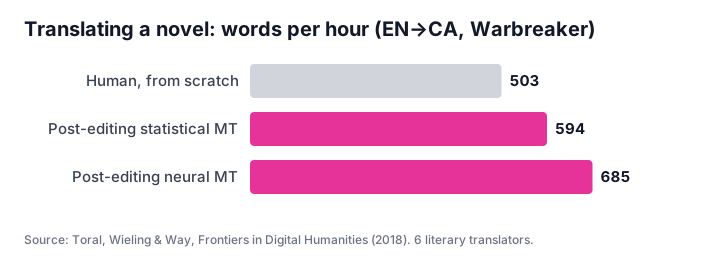
Data from Toral, Wieling & Way, 2018. Six literary translators, EN→CA.
On an actual novel, translators post-editing neural MT worked about 36% faster than translating from scratch. Software documentation shows bigger gains (one Autodesk study measured 74% on average). Fiction is harder.
The draft engine matters a lot. A weak draft can take longer to fix than translating fresh, so run a sample chapter before committing. PageTranslate was built for exactly this step. You upload the whole book file, get the same format back translated, and hand that file to your editor. It keeps character and place names consistent across the book, but there's no glossary upload yet, so give your editor a names list.
A quick way to decide
Answer these honestly.
- Who reads it? Just you, then a machine draft is fine. Paying readers need a human in the loop somewhere.
- Is the prose itself the selling point?
- What happens if one sentence is wrong. Embarrassment is survivable. A dosage error isn't.
- Budget. Under a few hundred dollars means AI draft plus the best bilingual reader you can find. Over $5,000 means you can afford a real translator, and for a debut you probably should.
- Deadline. A human needs weeks; a draft takes an afternoon.
The job market reflects all this. A 2024 Society of Authors survey found 36% of translators had already lost work to generative AI, while the US Bureau of Labor Statistics still projects small growth and notes machines can't yet match human work in most cases. Both things are true at once.
Related reading
- Machine translation post editing (MTPE)
- Google Translate is bad at books
- DeepL alternatives for books and documents
- How much does it cost to translate a book?
Put it in front of a bilingual reader before you decide anything.