How to Compare Translation Quotes (Beyond the Per-Word Price)
By PageTranslate Team · · 6 min read
Here is how to compare translation quotes. Turn each one into a total price for the same scope, divide by the number of source words, and check what is inside it, meaning a second linguist's revision, layout work, QA, rush fees, minimum charges and the revision policy. A per-word rate alone can't tell you any of that.
The 12-month example near the end (invented numbers, plain arithmetic) shows what that costs when you skip it. The vendor quoting $0.08 a word ends the year $5,000 more expensive than the one quoting $0.14.
Priced per 1,000 words. The total shows before you pay.
Why per-word rates mislead
Two quotes with the same word count can describe different jobs. One is a single freelancer working alone. The other adds a second linguist who compares the translation against the source (ISO 17100 calls that revision), then proofreading, then a project manager who answers your emails.
The Institute of Translation and Interpreting wrote in its buyer's guide that translation prices range from 1 to 10, or even 100. The American Translators Association says there are no standard going rates.
A published rate sheet shows how many lines can hide behind "per word". Washington State's 2025 contract with Dynamic Language Center lists $0.19 to $0.24 per word, rush work at $0.24 to $0.28, project minimums from $12.95 to $57.00, desktop publishing at $46.63 to $63.73 an hour, and proofreading billed on top at $0.09 to $0.13 per word. It's one vendor's government contract, which makes it an example and a poor guide to market averages. It does show the shape.
Hidden costs are the usual story. Formatting, quality checks and project management show up later as extras, or never show up and the work goes undone. The ATA tells of a retailer that paid twice after choosing a cheap agency.
What to pull out of every quote
- Rate and unit. Per word, per hour, per page or per line. A page is not a page. A 2017 tender from the European Commission's translation service counted a standard page as 1,500 characters without spaces in the source, roughly 250 words.
- Which words are counted. Source or target. Repeated and near-matching passages are often discounted. That tender paid 20% for 100% matches and 50% for 85 to 99% matches.
- Minimum charge. Small jobs hit it first.
- Rush fees, and the deadline at which they start.
- What's included. Translation only, or a second linguist's revision, or proofreading, or a formal QA step. This line changes the price more than any other.
- File handling. Formatting, desktop publishing and file conversion, particularly for scanned PDFs, InDesign files and EPUBs.
- Turnaround and capacity. Can they do your 50,000 words by Friday?
- Revisions and warranty. How long you have to report errors, and who pays to fix them.
Build a quote comparison matrix
Vendors go in the columns and criteria in the rows. Fill it in from the quotes, and leave a cell empty where a vendor hasn't said. An empty cell is information..
Here is an anonymized example for a 20,000-word manual going into Spanish. Every figure is invented.
| Vendor A | Vendor B | Vendor C | |
|---|---|---|---|
| What they sell | Translation only | Translation, revision and proofreading | AI draft plus human post-editing |
| Quoted price | $1,600 ($0.08 a word) | $2,800 ($0.14 a word) | $1,800 ($0.09 a word) |
| Extras outside the price | Layout, about $500 | None | Layout, about $300 |
| Total | $2,100 | $2,800 | $2,100 |
| Per-word equivalent | $0.105 | $0.14 | $0.105 |
| Who translates | Not stated | Named, native speaker, subject experience | Post-editor with subject experience |
| Quality steps | Spell check | Second linguist, then proofreader | Full post-editing pass, then a spot check |
| Deliverables | Word file | Word file and laid-out PDF | Word file |
| Revisions and warranty | 7 days, one round | 30 days, fixes for errors at no charge | 14 days |
Vendors A and C tie on total price and differ everywhere else. The per-word equivalent (total divided by words) is the row that makes unlike quotes comparable.
Questions to ask every translation provider
- Who will work on my project, and what are their qualifications? Names if possible, languages and subject experience.
- How do you keep terminology and style consistent inside this file and from one job to the next?
- InDesign, HTML, EPUB, scanned PDFs. Do you convert them, rebuild them or send them back to me?
- What happens if I find errors after delivery, and for how long? Get the number of days in writing.
- Later updates and version control. Can you support both?
- Which parts of ISO 17100 do you follow? As it's usually described, that means a qualified translator plus a second person who revises.
Ask for sample of similar work, or a short paid test. A vendor who dodges that is telling you something.
Red flags in translation quotes
Vague scope is the first. "Translation services" with no breakdown can mean anything.
No mention of editing or QA. Ask directly, in writing.
An impossible schedule. The ATA's old rule of thumb is 300 to 400 finished words an hour for one translator. At 350 an hour, 50,000 words is about 143 working hours, so a one-person quote that promises delivery by next Monday needs an explanation.
No clarity on file formats or layout work, which is where surprise invoices come from. And no samples, references or case studies, although a young firm may reasonably have fewer of those.
One more, and it's closer to a hunch than a rule. A rush fee that shows up only after you mention the deadline.
When a higher quote is actually cheaper
Fewer rounds of internal fixes. Fewer support tickets from a mistranslated instruction. Glossaries and style guides that pay you back on every later job. Those are real savings, and they rarely appear on the quote.
Here is a 12-month model with invented numbers. A 20,000-word manual is updated four times a year. Vendor A quotes $2,100 a release and their first pass needs 25 hours of your own review each time, plus one $3,000 correction when a wrong value reaches print. Vendor B quotes $2,800 and needs 5 hours. Review time is worth $60 an hour.
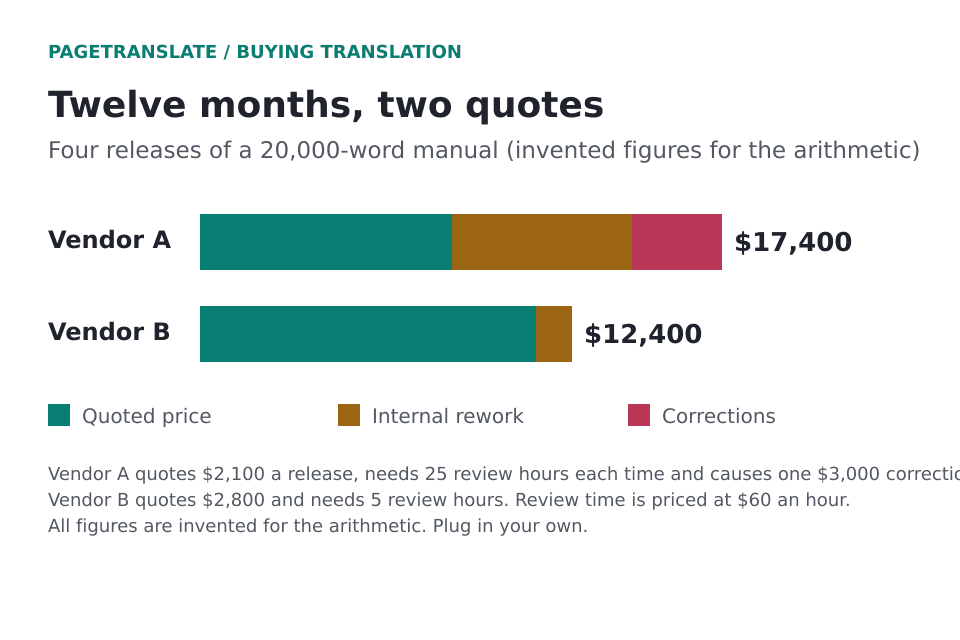
Vendor A comes to $8,400 in quotes, $6,000 in rework and $3,000 in corrections. Vendor B comes to $11,200 and $1,200. All figures are invented, so plug in your own.
Change the assumptions and the answer changes. Drop the correction and cut Vendor A's review time to 15 hours, and A comes out $400 ahead. That's the point of writing the model down.
Use PageTranslate to standardize and test
Comparable quotes need comparable inputs. Send every vendor the same editable source file and the same instructions. Add the same reference material, and the quotes that come back can sit side by side.
PageTranslate can serve as the pilot. A free account includes 3,000 starter words, which is enough for a chapter or a few pages. Translate it, give the result to your reviewer, and score it with the translation quality scorecard before you sign anything longer. The price is per 1,000 words, rounded up, and the cost FAQ explains the plan differences. For a whole manuscript, the book translation page shows what comes back.
Know the limits. The output is an AI draft returned in your file format. There's no glossary upload, translation memory or reviewer workflow, and it isn't a certified translation (use an accredited translator for immigration, court or government filings). For high-stakes content, pair it with a human reviewer, which is what an MT plus post-editing quote from an agency does anyway. Related reading includes machine translation post-editing and machine translation vs human translation. The guide to translating technical documents covers the high-stakes end.