Translation vs Transcreation: When to Adapt More Than Words
By PageTranslate Team · · 6 min read
Translation vs transcreation comes down to two questions. Translation asks whether the new text says the same thing. Transcreation asks whether it does the same job.
I tested that gap on October 2 with a four-word slogan, "Sleep better, live better.", and PageTranslate returned a fluent Spanish, French and German line in about ten seconds each. Nothing in those answers told me whether any of them would sell a mattress. That gap is what this article is about.
PDF, Word or EPUB, same format back. Exact price before you pay. Translation, not transcreation.
What translation is best for
Translation fits text where the source is authority. Manuals, contracts, specifications, reports, help articles and books all belong here. The reader needs what the author wrote, accurately and in natural language, and nobody wants a clever improvement.
Most of what PageTranslate handles is this kind of text. It translates documents and returns the same file format. It does not rewrite your message.
What transcreation is best for
Transcreation fits text meant to move someone. Ads, slogans, landing pages, social posts, video scripts, email subject lines and product names are the usual cases. The reader should feel something, or do something.
Morón and Calvo, writing in the Journal of Specialised Translation in 2018, describe the difference neatly. Translation and localization start from a source text and produce one target text. In transcreation the source is "subordinated to or replaced by" a creative brief, and the client often receives several options. Back-translation, a literal rendering of the new copy so the client can see what it says, is common, while translation memory is "not essential".
The American Translators Association's page on the subject gives a plain definition, recreating a text for the target audience.
Translation and transcreation side by side
| Translation | Transcreation | |
|---|---|---|
| Starting point | The source text | The creative brief |
| Goal | The same meaning | The same effect on the reader |
| Typical text | Manuals, contracts, reports, help content | Slogans, ads, landing pages, subject lines |
| Output | One target text | Often several options |
| Checking | Accuracy and terminology | Back-translation, in-market review |
| Time and cost | Usually per word | Often per hour or project |
The tidy split has a catch. Daniel Pedersen's 2014 paper in Cultus quotes the industry line that translation moves words and transcreation moves brands and messages, then calls that view of translation "rather simplistic". Translation theory has cared about effect for decades, through Nida, Eco and skopos theory. So the contrast is a useful working rule.
A worked example you can try
"Sleep better, live better." A literal pass is easy. The three drafts I got were these.
| Language | Draft | What it quietly decided |
|---|---|---|
| Spanish | Duerme mejor, vive mejor. | Informal "you" (tú) |
| French | Dormez mieux, vivez mieux. | Formal or plural "you" (vous) |
| German | Besser schlafen, besser leben. | Dropped the "you" and used infinitives |
None is wrong. But the tool chose a register in each language without being asked, and it kept the parallel structure of the English. A transcreator would start somewhere else, with questions. Who is the buyer? Is "live better" a promise the company can keep and is allowed to make in that country? Does the market care more about falling asleep, or about waking up? Which "you" fits the brand?
The answer might even be a different line. Below is an illustration I wrote to show the kind of choice, and it hasn't been tested with any audience.
| Option | What it keeps | Risk |
|---|---|---|
| Sleep better, live better. | The English structure | May sound flat or make a claim the market regulates |
| Wake up ready. | The benefit people feel in the morning | Drops the sleep idea |
| Rest. Then do more. | A rhythm and a two-beat feel | A bolder promise |
That is a conversation about the brief, and translation barely comes into it.
Real cases, and some myths
Real transcreation looks like Coca-Cola's name in China. According to Snopes' 1999 write-up, the company chose characters, 可口可乐, that sound close to the English name and roughly mean "to allow the mouth to be able to rejoice". The famous "bite the wax tadpole" came from shopkeepers' own signs, which the company had no hand in.
Kit Kat in Japan gets cited as a transcreation, and it isn't one. The name resembles "kitto katsu", which students use before exams, and BBC and Telegraph reports say Nestlé noticed the sales surge and leaned into it. The pun was a coincidence the company amplified. Spider-Man: India, published in 2004 with a hero named Pavitr Prabhakar, is a real adaptation case, cited by the Open University.
The Chevy Nova story is a myth. Snopes rates it false, since the car sold in Mexico and Venezuela from 1972 to 1978, and "no va" and "nova" are pronounced differently. I've left out the KFC "eat your fingers off" line because I couldn't find a primary source.
When you need both
A real launch needs a mix.. Say a company ships a smart lamp to Mexico (an invented example).
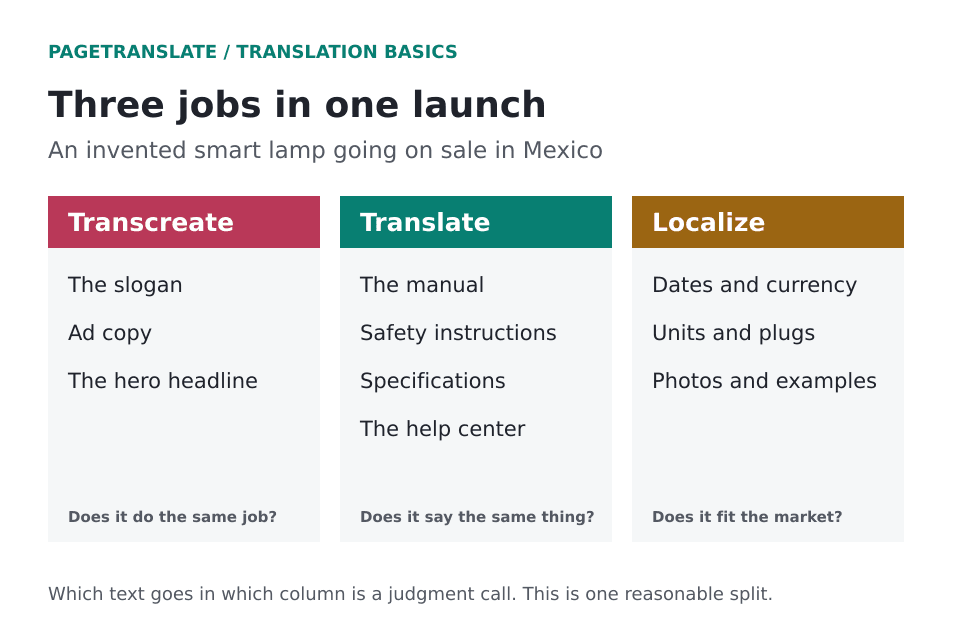
Who does what in a launch, by type of text.
Transcreate the slogan, the ad copy and the hero headline. Translate the manual, the safety instructions, the specs and the help center, where accuracy is what the buyer needs. Localize the rest, which is dates, currency, units and photos. For translation, a document tool does well, whether the source is a Word file or a PDF. For the first group you want a person with a brief.
How to brief a transcreation project
Morón and Calvo, citing a UK advertising brief standard, list what a creative brief usually covers. They name the campaign background, objectives, brand identity and values, the call to action, the audience, tone, the key message and where and when the copy appears. GALA's tips from Conversis add platforms and character limits, tone keywords, visuals and the brand vision, and recommend in-market copywriters.
So your brief should say who the buyer is, what the line must achieve, what you can't say, what the text is attached to, and how many characters fit. Ask for back-translation and a few options. And give it time, since GALA's tips suggest at least three working days even for a simple ad, plus a debrief. For quotes, how to compare translation quotes helps you read the line items.
How AI helps and where it stops
AI is useful for brainstorming options, drafting a back-translation and checking that nothing was dropped. A draft still needs a careful human pass, and the post-editing guide describes one. The evidence for more is thin. Khanuja and colleagues (2024) found image-editing models fail at culturally adapting pictures, with the best pipelines translating only 5 percent of images for some countries. A 2026 study of meme transcreation found models do it to a limited extent. A small 2025 study with 20 participants found students using GPT-3 produced Persian-to-English taglines that beat professionals', and it stressed human judgment in prompting and picking.
PageTranslate has no tone setting, no brand voice, no glossary and no market testing. So it fits the translate side of the split. See machine vs human translation for the wider trade, translation strategies for the choice between staying close and adapting, translation quality for checking a sample, and what is the purpose of translation for why the purpose comes first. The cost FAQ explains our pricing.