Translation Strategies: Methods, Techniques and How to Choose
By PageTranslate Team · · 6 min read
Translation strategies are the overall choices a translator makes about a whole text, and the biggest is whether the new reader should feel the source culture or forget it is there.
Take one syllable. Should "-san" survive in an English edition of a Japanese story? When Mixx and TokyoPop published Sailor Moon in 1998, the honorifics were dropped and the hero was shouted at as "Bunny!". Kodansha's 2011 edition kept "Tsukino-san!" and "Usagi-chan!". Same series, opposite decisions. That is a strategy question, and this guide gives you the vocabulary to make it on purpose.
PDF, Word or EPUB, same format back. Exact price before you pay.
Strategy, technique, method
These words collide in the literature. Molina and Hurtado Albir's 2002 paper in Meta notes that "different labels are used (procedures, techniques, strategies)", and then separates them. I follow their split, with one adjustment, since Vinay and Darbelnet's seven procedures are what most people call techniques.
| Word | What I mean by it | Who uses it differently |
|---|---|---|
| Strategy | The overall approach to a whole text, such as domesticating | Molina and Hurtado Albir call this a method, and reserve strategy for problem-solving during the work |
| Method | One of Newmark's eight positions between the source and the reader | Newmark says methods cover whole texts and procedures cover smaller units |
| Technique | A specific move on a word or phrase, such as borrowing | Vinay and Darbelnet call these procedures |
So if a source says "strategies" and lists borrowing and calque, it is probably using the word loosely. Nothing is wrong with that. It just helps to know.
Domestication and foreignization
In 1813 Friedrich Schleiermacher said a translator has two roads. Leave the author in peace and move the reader toward him, or leave the reader in peace and move the author toward them. Lawrence Venuti later gave the roads their modern names in The Translator's Invisibility (1995). A domesticating method makes the text read as if it had been written in the target language. A foreignizing method lets the source's differences show.
Venuti adds a warning. He calls the "foreign" in foreignizing a strategic construction, so what feels foreign depends on who is reading. Leaving "-san" in is foreignizing for many American readers, but for people raised on subtitled anime it may look plain.
Researchers have documented both choices. The Yakuza 0 localization left san, kun, sama and chan untranslated, which Almeida Santos and Humblé (2023) call not uncommon in Japanese audiovisual media. The Sailor Moon case comes from Sleeper and Iskos (2021). Manga vs light novel shows how this plays out when you translate a Japanese novel yourself, and the AI novel translator page covers fiction in general.
Vinay and Darbelnet's seven techniques
Jean-Paul Vinay and Jean Darbelnet published their comparison of French and English in 1958. They sorted translation moves into two groups. Direct translation includes borrowing, calque and literal translation, and oblique translation includes transposition, modulation, equivalence and adaptation. The examples below are theirs, except the Spanish ones, which Molina and Hurtado Albir give.
| Technique | What it does | Example |
|---|---|---|
| Borrowing | Takes the word as it is | tequila, or bulldozer in French |
| Calque | Copies the structure and translates the parts | "Compliments of the Season!" to "Compliments de la saison!" |
| Literal | Word for word, and it works | "I left my spectacles on the table downstairs" to "J'ai laissé mes lunettes sur la table en bas" |
| Transposition | Changes the word class | "Défense de fumer" and "No smoking", or "He will soon be back" to "No tardará en venir" |
| Modulation | Changes the point of view | "It is not difficult to show" to "Il est facile de démontrer" |
| Equivalence | Different wording for the same situation | "Aïe!" and "Ouch!", or "Like a bull in a china shop" and "Comme un chien dans un jeu de quilles" |
| Adaptation | Swaps a cultural reference | A cycling reference in French becomes cricket in a British version and baseball in an American one |
Two cautions. The techniques overlap, and Vinay and Darbelnet themselves note that one sign can be three of them at once. And Molina and Hurtado Albir argue the original examples were stripped of context, so treat any single label as a conversation starter. For the full list with Pym's commentary, see his 2014 paper.
Newmark's eight methods
Peter Newmark's A Textbook of Translation (1988) arranges eight methods on a V. On the source-language side are word-for-word, literal, faithful and semantic. On the target-language side are adaptation, free, idiomatic and communicative.
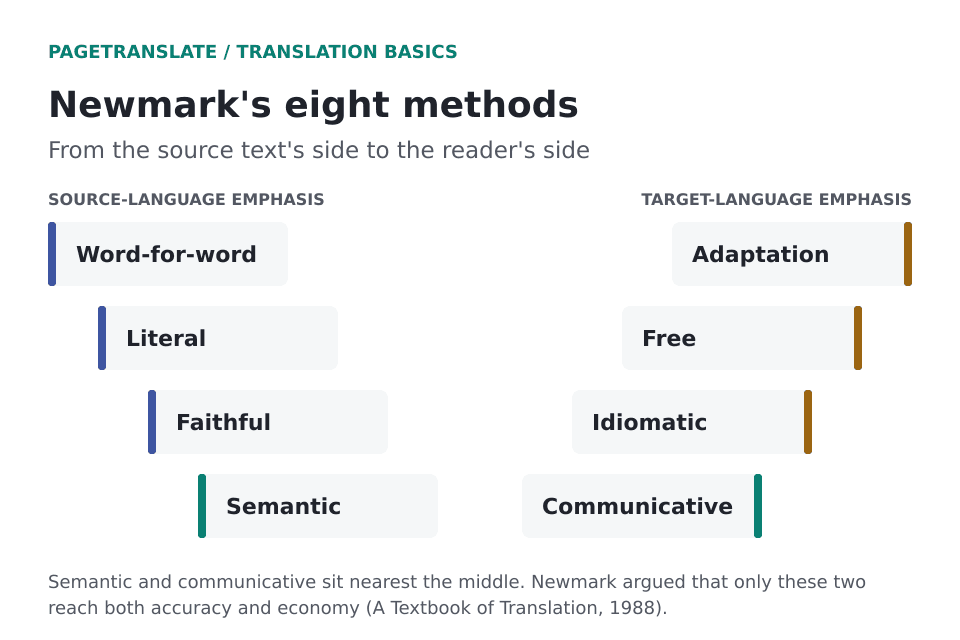
Newmark's eight methods, from the source text's side to the reader's side.
Newmark held that only semantic and communicative translation reach both accuracy and economy. Semantic translation stays at the author's linguistic level and suits expressive texts. Communicative translation works at the reader's level, which suits informative and persuasive texts. If you want one rule of thumb, I'd use that. It is a simplification, and I could be wrong about how much a modern reader needs the distinction.
How to choose a strategy
Skopos theory, from Hans Vermeer's 1978 framework and later work with Katharina Reiss, says the purpose of the translation decides. Four questions turn that into working habit.
- Who will read it, and what will they do next?
- What happens if they misunderstand it?
- Does the source culture add something the reader came for?
- What limits apply, such as a character count or a legal structure?
Here is how it looks for four invented texts.
| Text | Likely approach | Why |
|---|---|---|
| A button labelled "Save changes" | Domesticate, using the term users already know | Users want to finish a task, and the label has a length limit |
| A lease clause saying the tenant "shall not sublet" | Stay close and keep the structure | The obligation has to survive exactly |
| Dialogue in a novel with an honorific | Depends on the edition's house style | The voice matters and readers differ |
| A product headline | Adapt, or hand it to a transcreator | The effect matters more than the words, see translation vs transcreation |
The purpose of translation post goes further into why the same sentence can be right in one setting and wrong in another.
What I found when I ran a probe
PageTranslate has no strategy setting. I wanted to see what it does by default, so on October 2 I ran a ten-sentence English document into Spanish and a four-line Japanese one into English, once each. Another run might choose differently..
| Source | Draft | What it did |
|---|---|---|
| It's raining cats and dogs. | Está lloviendo a cántaros. | Equivalence |
| They are as like as two peas. | Son como dos gotas de agua. | Equivalence |
| Compliments of the Season! | ¡Felices fiestas! | Equivalence, where Vinay and Darbelnet's French example is a calque |
| Let's play baseball on Saturday. | Juguemos al béisbol el sábado. | Kept baseball, no adaptation |
| 田中さん、おはようございます。 | Good morning, Mr. Tanaka. | Honorific swapped for Mr. |
| お兄ちゃん、待って! | Wait, big brother! | Kinship term translated |
So the default leans toward domestication. It reached for the equivalent idiom on all three expressions, and it dropped "-san" without being asked. If you want foreignization, you'll edit the draft yourself, and with no glossary upload you check names and terms by hand. The post-editing guide describes that pass, and translation quality explains how to judge a sample.
Where AI fits
Studies say little about strategy. A 2023 WMT paper by Karpinska and Iyyer found GPT-3.5 translating a whole literary paragraph beat sentence-by-sentence output, with fewer mistranslations. It also said critical errors remained and a human translator stayed necessary. The WMT24 findings had professional annotators rank systems on 11 language pairs, with Claude-3.5-Sonnet first on nine. Scalena and colleagues (2026) found models handle stated style constraints but struggle when style is only implied by examples.
I found no solid study showing that a language model reliably follows a domesticating or foreignizing instruction. Engines also differ in their habits, and the guide to DeepL alternatives compares the main options for documents. These results are from 2023 and 2024 models too, so read them as a floor. Still, the safe reading is that the strategy decision belongs to a person. The machine vs human translation post covers where each wins.