What Is the Purpose of Translation? (And Why It Matters)
By PageTranslate Team · · 5 min read
Search for what is the purpose of translation and the first results are mostly about protein synthesis, so to be clear, this page is about language. Its purpose is to let people use anything written in a language they don't read, from instructions to novels, with the meaning and intent intact.
A hospital consent form and a shop's checkout page sit at opposite ends of the same job. US rules for research consent require that information be "in language understandable to the subject", and a 2020 CSA Research survey of 8,709 consumers in 29 countries found that 76 percent of online shoppers prefer to buy products with information in their own language. Understanding and buying both depend on translation.
PDF, Word or EPUB, same format back. Exact price before you pay.
The core purpose, making meaning accessible across languages
Translation is rendering what a text means, and what it is trying to do, into another language so its new readers can use it as the original readers could.
The standard definitions agree on the medium. ISO 17100 defines translation as a set of processes "to render source language content into target language content in written form". Reiss and Vermeer's Skopos theory adds the point that matters here. The purpose of a translation in its target situation decides how to translate, and equivalence to the source is only one way to serve it.
That is why a good translator reproduces intent, tone, register and cultural relevance, which a word-for-word swap can't do. The profession that does the same for speech is covered in the difference between interpreter and translator.
The main purposes of translation
- Communication. Helping people understand each other across a language barrier, whether in a letter or a legal notice.
- Access. Making education, healthcare, government services and legal information usable. The EU runs on 24 official languages, and its translation service puts the principle bluntly, "No EU legislation without translation."
- Commerce. Selling, supporting and operating in new markets, where CSA Research's 2020 survey also found that 40 percent of online shoppers will never buy from sites in other languages (it is self-reported, and six years old).
- Culture. Putting literature, film, games and media in front of readers who would never meet them otherwise.
- Knowledge. Moving research, technical documentation and historical material across borders, the territory of our guide to translating technical documents.
- Compliance. Meeting legal and regulatory rules. EU Regulation 2017/745 requires device information in an official Union language set by the Member State, and Regulation 1169/2011 requires mandatory food information in a language consumers in that country easily understand.
Translation vs localization, and what changes
The W3C defines localization as adapting content to the language, cultural and other requirements of a specific market. Translation is the language part of that. Localization also touches date formats, currency, images, humor, product names and legal references. The LISA primer's examples include Norwegian å sorting after z and local payment methods.
Take "Black Friday". In the UK it caught on only after Amazon began Black Friday discounts in 2010, with Asda, Tesco and Sainsbury's following in 2013 and 2014. A campaign for a market where the name means nothing has two sensible options. Explain it in a line, or build around the local peak instead, such as Mexico's El Buen Fin (since 2011) or China's Singles' Day, which began at Nanjing University in 1993 and which Alibaba took up in 2009.
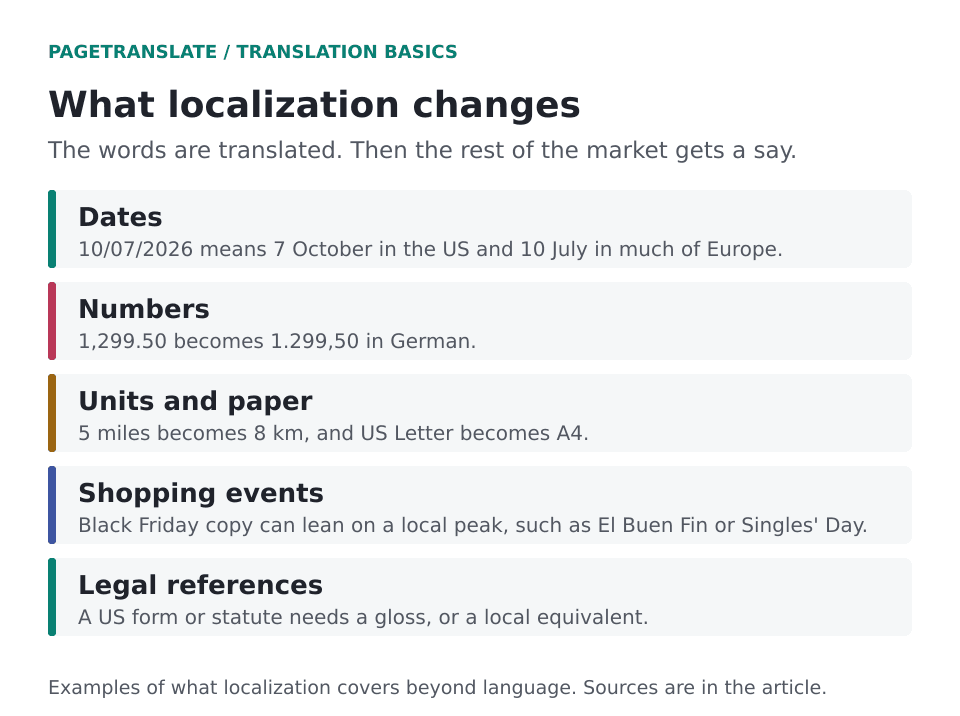
Localization goes past the words.
What makes a translation successful
Four checks cover most of it. Accuracy asks whether the target says what the source means. Fluency asks whether a native reader would think it was written in their language. Purpose fit asks whether it works for its audience and its use. And consistency keeps terms, names and style stable from page to page.
These map loosely onto the MQM error types, with accuracy and terminology on one side and linguistic conventions, style and audience on the other. If you want to measure them, the translation quality scorecard is a one-page version.
Four purposes in four short examples
A medical consent form exists for comprehension and safety. If patient can't follow it, the signature means little, which is why the rules say "understandable".
A product page exists to persuade. The same sentence can be accurate and still lose the sale if it sounds like a manual.
A novel exists for voice and atmosphere,, and the translator's job is to make a reader in another language feel what the first readers felt.
A software interface exists for clarity. "Save changes" has to read like a button people press without thinking, and every screen has to use the same word for it.
When human judgment matters most
Ambiguity, idioms, humor, legal risk, brand voice, cultural sensitivity and high-stakes instructions all need a human who knows the subject. Machine translation helps with first drafts, internal material, a quick read of something foreign and large volumes of repetitive text.
Review, or a professional translator, is the norm for contracts, medical content, public brand copy and safety information. The numbers explain why. In the 2019 JAMA study, Google Translate got 92 percent of Spanish sentences and 81 percent of Chinese sentences right, and 2 percent and 8 percent of them carried potential for clinical harm. Those are old figures for a tool that has changed, so treat them as a reason to check. How the two approaches differ in practice is covered in machine translation vs human translation and in the guide to post-editing. If you are buying that review from a vendor, how to compare translation quotes lists what to ask.
How PageTranslate supports the purpose
You upload a PDF, Word or EPUB file, see the exact price, choose the language and download the translated file in the same format. The whole document is translated in one job, which helps names and terms stay stable. Scanned PDFs in six languages are read first (how scanned PDFs are handled), and EPUB output keeps its chapters and table of contents (see opening an EPUB on Kindle). If you have paper originals, turning a scanned document into a PDF comes first, and batch OCR handles whole folders.
It is a draft, and the limits are real. There is no certified or sworn translation, no glossary upload, no translation memory and no reviewer workflow, and a person who reads the target language should review anything that matters. The goal is a usable result for the audience, and review is how you confirm you got there. For a long manuscript, start with the book translation page.