Public Domain Short Stories: Where to Find Them and How to Use Them Legally
By PageTranslate Team · · 6 min read
Public domain short stories are free to translate, adapt and republish wherever the copyright has expired, and in the US that now covers everything first published before 1931. The catch is that "public domain" belongs to one work, in one country, on one date, and the edition on your screen can carry rights the story doesn't.
Constance Garnett's English Chekhov shows how it goes wrong. Chekhov wrote "The Lady with the Dog" in 1899, but Garnett's translation is a separate work, and she died in 1946. It is free in the US and in countries that count 70 years from death, and still protected in any country that counts 100. None of this is legal advice, so verify the work, the edition and the country before you publish.
PDF, Word or EPUB, same format back. Exact price before you pay.
What "public domain" means for a short story
A work is in the public domain in a given country when its copyright has expired or never applied there. After that it can generally be reused, translated, adapted and republished in that country without permission.
The US Copyright Office's Circular 15A says all works published in the US before January 1, 1931 are in the public domain, and Duke's Public Domain Day 2026 page confirms that 1930 works entered on January 1, 2026. Works from 1931 follow on January 1, 2027, by Duke's 96-year count. Elsewhere the usual rule is the author's life plus 70 years (the EU's 2006 directive, the UK, Canada since December 30, 2022, and Japan's act), with Berne setting a floor of life plus 50. Berne's rule of the shorter term also lets a country cap a foreign work at the term of its country of origin, so the answer can differ again for foreign works.
Duke's example makes it concrete. Maugham's Cakes and Ale (1930) is public domain in the US in 2026 and protected elsewhere until 2036, because Maugham died in 1965.
Why public domain stories are useful
You can translate, annotate, illustrate, serialize or publish them with far fewer rights hurdles. They work for building an ebook catalog, for language-learning material, and for a translated collection. You can also pair an original with your own translation yourself, which is how people make bilingual editions.
They join up two things people often treat separately. Finding a story flows naturally into translating it and then publishing it, and the rights check sits at the start.
Where to find public domain short stories
- Project Gutenberg. A large library of US public domain ebooks. Its terms say users outside the US must check local law, and each ebook carries its own license text.
- Internet Archive and Open Library. Scans of older books and magazines. The Archive says it makes no guarantee of a work's copyright status, so the checking is yours.
- Wikisource. Community transcriptions. Its translations are derivative works, and contributors' translations are licensed CC BY-SA, which has its own conditions.
- Library digital collections. University and national libraries, strong on old periodicals and anthologies.
Before you pick a story, write down the author's death year, the first publication date and country, the exact edition, who translated or illustrated it, and the platform's terms.
Here is a starter list. Each Gutenberg record says "Public domain in the USA".
| Story | Author | First published | Check before using |
|---|---|---|---|
| The Yellow Wallpaper | Gilman | 1892 | Original English |
| An Occurrence at Owl Creek Bridge | Bierce | 1890 | Original English. Gutenberg's death year for Bierce is marked uncertain |
| The Gift of the Magi | O. Henry | 1905 | Original English |
| The Monkey's Paw | W. W. Jacobs | 1902 | The edition credits two illustrators, and pictures are separate works |
| The Happy Prince and Other Tales | Wilde | 1888 | Original English, a collection |
| The Lady with the Dog | Chekhov | 1899 | Garnett's translation, she died in 1946 |
| What Men Live By | Tolstoy | 1885 | Maude translation. Gutenberg gives no year for it, so confirm |
| The Necklace | Maupassant | 1884 | Gutenberg's page does not make clear who translated this story |
The last row is a lesson in itself. If you can't tell who made the translation, you can't tell whether it is free to use.
How to check whether a story is public domain
Identify the author, the first publication date, the country and the exact edition. Then check the rule for each country that matters to you.
In the US, anything published before 1931 is in the public domain. For 1931 to 1963 the answer depends on whether the work carried a notice and was renewed. Cornell's chart explains it, and a 1961 study it cites found that fewer than 15 percent of works were renewed, but that is a rule of thumb and Duke warns the records are fragmentary.
Then look at the edition. The Copyright Office's Circular 14 says a translation is a derivative work whose copyright covers only the new material, and that it "will not prevent anyone else from using the same public domain work". An introduction or a set of illustrations may have its own copyright too, and so may a modern edition. Project Gutenberg puts it plainly, "Every translation has independent copyright restriction."
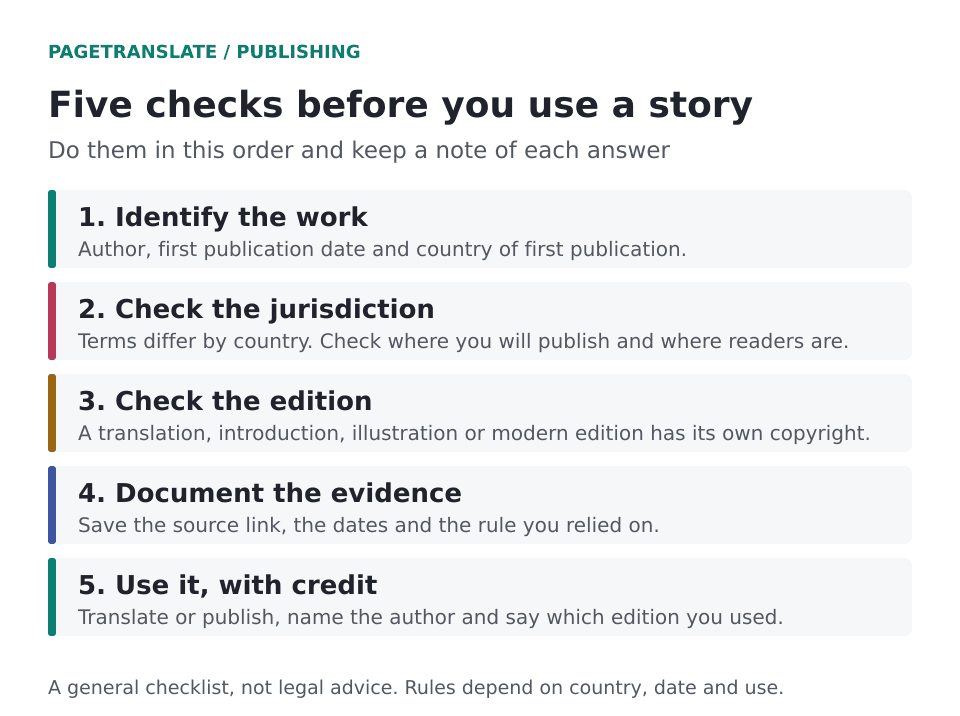
A checklist to keep with the file.
Translating a public domain story
Pick a story with a clear rights status and a defined audience. Write one-page style guide covering tone, era, dialect, names and how to handle references that don't travel.
PageTranslate can produce a first draft from an EPUB, PDF or Word file and return it in the same format, with the price shown first. It is a draft. It has no glossary upload, so check names in the first pages, and it is not a certified translation. Read the result against the original and edit it into natural prose, as the guide to post-editing describes.
Rights matter here too. The Copyright Office's January 2025 report says copyright does not extend to purely AI-generated material, while AI used to assist human creativity does not affect protection for the result, judged case by case. It doesn't rule on machine translation, so I'd treat a raw AI draft as having little protection of its own and your human edits as yours. The story itself stays free either way.
Publishing a translated story
The options include a blog series, a newsletter, a PDF, an EPUB, a print collection or an audiobook. For ebooks, epub or mobi for Kindle and how to edit EPUB files cover the format and the cleanup.
Add something of your own. Footnotes, historical context, your own pictures and a short note on the translation all help readers, and on Amazon KDP they matter for another reason. KDP allows public domain content and may ask for proof. If a free version of the title exists, it publishes only a differentiated one, meaning an original translation, original annotations or at least ten original illustrations, marked (Translated), (Annotated) or (Illustrated) in the title. A linked table of contents, formatting improvements and collections don't count, and public domain content isn't eligible for every royalty option or for KDP Select.
The wider picture of costs and rights is in how hard is it to get a book published, and the Spanish route and the EPUB translator show what a translated file looks like. For pricing, see the cost FAQ. If you plan a Kindle edition, the Kindle translation guide explains the reader's side.
Common rights mistakes
Assuming "old" means public domain everywhere is the usual one. A modern translation or annotated edition is the next, and people forget it has its own copyright. Public domain and Creative Commons also get confused. CC0 is a waiver by a rightsholder, and a CC license is a set of conditions on a work that is still copyrighted, so neither is a synonym for the public domain.
Last is publishing under a new title without keeping the source and the credit.. Save the link and the date, note the rule you relied on, and name the author and the edition. If a publisher or platform asks for proof, you'll have it.