How Hard Is It to Get a Book Published? (Traditional, Self, and Translated Editions)
By PageTranslate Team · · 7 min read
How hard is it to get a book published? Through a traditional publisher it is hard and slow, and nobody has a rigorous industry-wide number. The best public figures come from six agents who shared their data in 2020, and their offers of representation were usually under 1% of queries. Self-published, it is easy to do, since a book on Amazon KDP goes live in about three business days, and it costs anywhere from almost nothing to roughly $9,000 for an 80,000-word novel.
The figures that circulate (1%, 2%, "one in a hundred") mostly can't be traced to a source. Below is what can be, with dates, and where nobody has data the text says so.
AI draft in your file format. The exact price shows before you pay.
The short answer depends on the path
Traditional publishing means an agent sells your manuscript to a publisher. It is selective and slow, and almost everything is done for you once a deal lands. Self-publishing has no gatekeeper. You pay for, or do, the editing and the cover and the layout and the marketing. Hybrid publishing sits between them and varies enormously, partly because some "hybrid" companies behave like vanity presses (more on that below).
"Published" also means two things now. Accepted by a publisher is hard. Available to buy is easy, since a book on Amazon KDP goes live in about three business days. Finding readers is hard on both roads..
Traditional publishing
For fiction you normally finish the manuscript, query agents, and wait. For nonfiction you usually sell a proposal first. The agent then submits to editors. Jane Friedman estimates that roughly 80 percent of acquisitions at New York houses come through agents, and Penguin's UK guide says most major publishers don't take manuscripts directly from writers.
The odds. Nobody has a rigorous industry-wide figure. The best public numbers are self-reported by six agents in 2020 (Darling Axe). They each received 200 to 5,000 queries a year. Full-manuscript requests ran from about 1% to 15% of queries, and offers of representation were usually below 1%. One agent with 5,000 queries made offers to roughly 0.2%. That's a small sample from six people, and it describes agents. Publishers' acceptance rates remain a separate unknown.
The wait. In a survey of agents on Jane Friedman's site (August 2026), 55% of agents take two to eight weeks to start reading a requested manuscript, and she advises waiting ten weeks before nudging. Books & Such, a literary agency, wrote in 2014 that pitching can take two months to two years and that publication follows a contract by one to two years.
The money. The Authors Guild's model contract lists hardcover royalties of 10% of list price on the first 5,000 copies, 12.5% on the next 5,000 and 15% after that, 7.5% on trade paperback and 25% of net receipts on ebooks. Real contracts vary. Agents take 15% of domestic income and 20% when a sub-agent handles a foreign deal.
What publishers look for is a polished manuscript, a clear sense of who will buy it, comparable titles that sold, and for nonfiction an author who can reach readers. In return you get editing, design, distribution and sometimes an advance. You give up speed and much of the control, and your rights stay licensed for years.
Self-publishing
The main doors are Amazon KDP, Kobo Writing Life, Draft2Digital (an aggregator that sends your book to other stores) and IngramSpark for print distribution. These are the terms as of October 2, 2026.
| Platform | What to know |
|---|---|
| KDP ebooks | 70% royalty band for list prices of $2.99 to $12.99 at Amazon.com (effective July 7, 2026), 35% otherwise. Delivery cost is $0.15 per MB. |
| KDP paperbacks | 50% royalty through $9.98, 60% from $9.99, minus printing cost. Its free ISBN covers paperback and hardcover only, works only on KDP and shows "Independently published". |
| Kobo Writing Life | No distribution fee. 70% at $2.99 or more in the US, 45% below. |
| Draft2Digital | $20 one-time activation for new accounts, and $12 a year maintenance when net earnings stay under $100 across the previous 12 months (May 14, 2026). So "free to list" needs an asterisk there. |
| IngramSpark | Its current fee schedule sits behind a login and sources conflict, so check it yourself. |
Everything else is yours. Editing, cover, layout, metadata, pricing, taxes, marketing. For an 80,000-word novel at 2026 US freelancer rates, the Editorial Freelancers Association's median ranges are 3.0 to 3.5 cents a word for a developmental edit of fiction, 2.0 to 2.7 for a copyedit and 1.2 to 2.0 for a proofread. Reedsy, which analyzed more than 230,000 quotes, puts the middle half of covers at $630 to $1,200 and of interiors at $475 to $1,275.
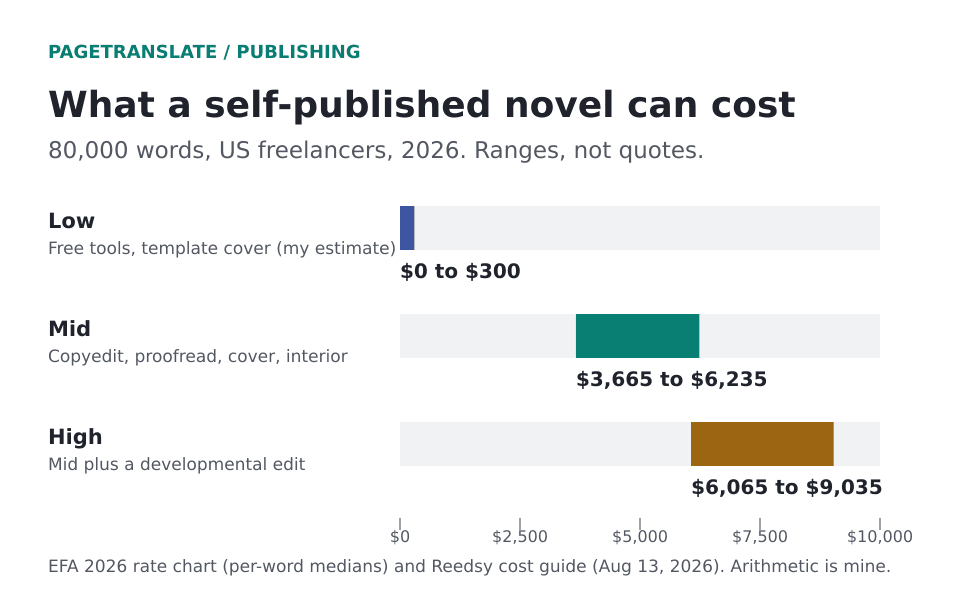
Three budgets for the same novel. The low bar is my own estimate. The other two add up published ranges.
My hunch (and it's only a hunch) is that first-time authors overspend on covers and underspend on the last proofread. A manuscript that waits another month for proofreader loses nothing. One that ships with errors keeps them.
Self-publishing offers control and speed, plus a bigger share of each sale. The cost is that every weak link is yours, including visibility, which no platform guarantees. Please don't buy reviews.
Is your manuscript ready?
- Structural edit finished, with beta readers' feedback worked in?
- A professional copyedit and a separate proofread.
- One sentence that says who it's for and which published books it sits beside.
- Platform. For nonfiction, some way to reach readers already, or a concrete plan to build one.
- Rights in order. Every image, quotation and co-author agreement.
A pass isn't a verdict on your talent. Agents decline for many reasons, and fit is only one of them.
Costs and timelines compared
| Traditional | Self-publishing | |
|---|---|---|
| Upfront cost to you | None. A reading fee is a warning sign. | Roughly $0 to $9,000 for a novel, depending on how much help you buy |
| Time to market | Months to find an agent, then one to two years from contract to shelves | Days after upload, plus the production time you choose |
| Royalty | Model contract rates above, less the agent's 15% | KDP's 70% ebook band and 50% or 60% on paperbacks, minus printing |
| Control of price, cover and rights | The publisher decides most of it | You decide, and you keep the rights |
| Reach | Bookstore and library channels come with the deal | Online retail by default, and the rest takes extra work |
Publishing translated editions
Translation makes sense when the book already sells, the genre travels, you control the translation rights and there's a budget. Two routes.
Sell the rights. A foreign publisher licenses your book, usually through an agent or sub-agent. The Authors Guild says the author's share of a typical foreign-rights deal is 75% of net proceeds, up to 80% in the UK. It is uncommon for authors, even self-published ones, to sell their own foreign rights (Publishing Perspectives, 2013, so treat it as dated). If a publisher already holds your world rights, check the contract before you do anything.
Publish the translation yourself. Literary translators averaged 13 cents a word in a PEN America survey, as reported by the Authors Guild, with 10 cents or less the most common rate and a range from 1 cent to over 40. At 13 cents, 80,000 words is about $10,400 (my arithmetic). An AI draft followed by a native-speaking editor costs far less, though the editor's judgment is the part you're paying for. Amazon's Kindle Translate beta is invite-only and covers English to French, German, Italian, Brazilian Portuguese and Spanish, and back to English (details here).
Each language edition then needs its own ISBN wherever you assign them yourself. ISBN.org says each language version is a different product, and Bowker lists $125 for one ISBN and $295 for ten. Add formatting for each retailer, and a look at what readers in that market expect from covers and prices.
PageTranslate translates a whole EPUB, PDF or Word file and returns the same format, with the exact price shown before you pay (how pricing works). Output is an AI draft. It is not a literary or certified translation and has no side-by-side view. A fluent editor should read it before anyone buys it. For a first test, see Spanish, and for the EPUB side see the EPUB translator. A lower-cost launch is covered in how to publish a book for free.
Pitfalls that make publishing harder
Rushing is the common one. Skipping a real editor and a readable cover is next. Then there's no plan for finding readers, and a murky rights situation, which gets worse with translated or co-authored books.
Then the predators. Writer Beware says a vanity press charges the author or requires a purchase, and its warning signs include no firm price, promises made only verbally, and pressure to sign fast. The IBPA revised its hybrid-publisher criteria on September 1, 2022, to 11 points. If a company can't show you a contract, its list of recent titles and where the books are actually sold, walk away. The Amazon-side trade-offs are in self-publishing on Amazon, pros and cons.