Self Publishing on Amazon Pros and Cons
By PageTranslate Team · · 9 min read
Does self-publishing on Amazon have its pros and cons? Yes! Amazon KDP (Kindle Direct Publishing) offers the author access to Amazon’s millions of readers for the ebook (and print-on-demand book) if they are willing to take on the responsibilities of production and marketing. How much will you make depends on several factors including the format of your book, its price, and the KDP program that you choose.
We treat non-KDP Select (so-called “ordinary”) KDP publishing and the optional KDP Select service separately. The given information on the respective Amazon terms was retrieved on October 2, 2026.
No-upload-fee routes, with costs explained.
The advantages and disadvantages at a glance
Note that the earnings listed are for example purposes only, in other words they are not actual author earnings from their book sales.
| Advantage | Corresponding trade-off | What you can do |
|---|---|---|
| Direct access to Amazon readers | A listing does not guarantee discovery | Validate the audience, cover and description before spending on ads |
| No publishing setup fee | Editing, design and review remain your responsibility | Define the production budget separately |
| Control over the edition | You own the decisions and their consequences | Keep source files and a release checklist |
| Print-on-demand | Printing can leave a thin margin | Calculate proceeds with your actual specifications |
| Optional Kindle Unlimited reach through Select | Ebook exclusivity and renewal management | Compare Select with nonexclusive distribution |
| A single direct dashboard | Concentration in one platform | Keep backups, reports and a distribution plan |
| Ability to submit corrections | Not every metadata or edition change is a simple edit | Review carefully before launch and follow current update rules |
One advantage of managing an edition directly as an author is that you have control over the work. Of course, this also means that you have to find people or tools to help edit, create covers, and more for you to use in your production.
Pro: you can publish without a gatekeeper or inventory order
A short introduction into Amazon's free ebook and free paperback publishing services. The overview also discusses free hardcover publishing and how Amazon print-on-demand functions for copies of the print version of your author book. No prior publishing contracts are required to put your new work into print. Large print runs of unsold copies of the physical book are not required.
Remember that just because you are publishing for free, does not mean that production and marketing costs are zero. Those costs have to be budgeted for as well and most can be done by the author themselves provided they have the time to do so. We would write and complete the opening pages of our book, as well as the book description and cover before we even think about Advertising our book.
The use of print-on-demand means that there is no unsold stock of printed books, but a proof print of your edition would be a worthwhile investment as this highlights potential problems with the margins, images, and print readability of your eBook.
Con: free submission does not remove production or marketing costs
Note that there is no publishing fee for an Amazon Kindle Direct Publishing (KDP) book, but there are other costs to consider when preparing a manuscript for print-on-demand distribution. There are costs for editing, cover design, formatting, proofreading, rights to use any included photographs, translation, and print proofs as well as marketing and advertising of the finished book.
Only finish the opening pages, description and cover before buying traffic with advertisements. Those parts are the only parts that any prospective reader will read and see before buying your book.
Consider your marketing budget in terms of how much you will spend above the retail price of your book and how that will compare to your return on investment from online advertising such as Amazon advertising.
Ebook royalties and the current US price range
Amazon KDP offers authors two royalty rates for their ebooks: 35% and 70%. How the author sets their price for their ebook and the relevant taxes and delivery charges for the customer’s territory all impact on the royalties the author can receive. Also, word-based ebooks such as prose generally contain less content than an illustrated ebook and therefore cost the author less to deliver to the customer.
To earn 70% on Amazon.com sales of your eBook, your list price must fall within the range of $2.99 to $12.99, effective July 7, 2026. Prior versions of this guide mentioned a range of $2.99 – $9.99. The new ranges for other territories are listed by marketplace and customer territory in the list-price requirements section of Amazon's list-price requirements page.
Authors can go to the pricing screen of KDP to get an estimate. It’s best to check the marketplace (e.g. Amazon.com) and customer territory as well as the price to see that the author will get the same percentage on all his sales. (And note that paperback royalties are calculated differently than ebook royalties.)
Calculate your paperback margin
Paperback sold on Amazon.com gets 50% royalty for hard cover sized books up to $9.98 and 60% for books priced at $9.99 or higher. Then you subtract out the cost of printing. All of this is covered on Amazon’s paperback page, which also describes the calculation for books sold through KDP’s Expanded Distribution.
Around $9.99 KDP switches to a higher royalty rate for paperback sales. Using the same assumed cost for the printing of $4.60 per copy for an assumed manuscript of moderate length, this means that for each book sold at this higher price point the author would earn around $1.39 per book, compared to $0.39 per book for sales at $9.98.
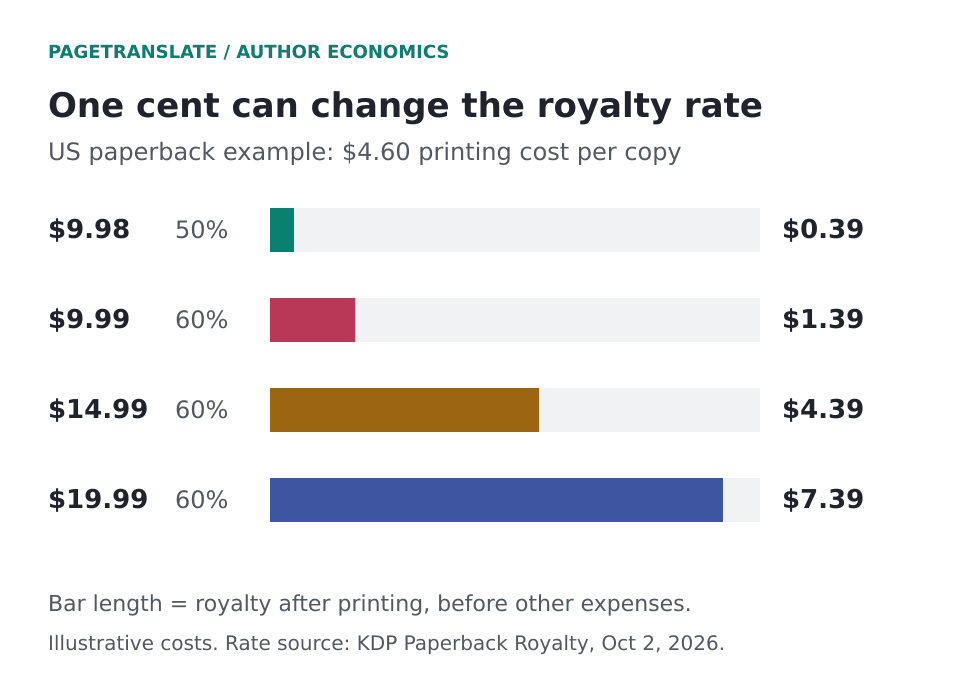
For these examples, we are assuming a printing cost of $4.60 per book. However, this cost will vary depending on many factors including the specifications of your manuscript, the trim size, the number of colors in the ink used for the cover and interior images, and the marketplace in which you are selling your book.
US paperback margin estimator
$1.39 per copy (60% royalty rate)
72 copies to recover $100.00.
Amazon.com paperback sales only. Enter the printing cost from KDP for your specifications. Excludes tax, ads, returns, shipping and Expanded Distribution. This is an estimate, not price eligibility approval. Rates checked October 2, 2026.
Use KDP's printing cost for your book's number of pages, size, type of ink, etc. Then enter the list price and production budget. The calculator estimates royalties per copy and the number of copies needed to recover that budget; it does not determine your selling price. Note that taxes, advertising, returns, and shipping are not factored into this estimate.
Additionally, the price you set for your work can play a crucial role in the decision making process of your readers. While the margin per book may increase as the price rises, the total you receive for each book will always be the margin times the number of books sold. Thus, a higher margin per book does not necessarily translate into higher earnings overall.
KDP, KDP Select and Kindle Unlimited are different
| Term | Meaning | Distribution consequence |
|---|---|---|
| KDP | Amazon's self-publishing platform | Ordinary publishing does not require exclusivity |
| KDP Select | Optional 90-day ebook program | Commits the ebook to the program's exclusivity rules |
| Kindle Unlimited | Reader subscription that includes eligible Select ebooks | Author proceeds depend on eligible reading, not a guaranteed fixed amount per book |
| Going wide | Publishing through multiple ebook channels | Requires checking that no conflicting exclusivity commitment is active |
Note that the current Amazon Select terms allow authors to distribute their ebook through KDP (as well as to public libraries), and to have print and audiobooks distributed elsewhere. In addition, KDP automatically renews enrollment in Select for another 90 days unless the author opts out, and note that simply unpublishing a book does not terminate any current commitments under Select terms.
Note that this exception only refers to public libraries and not to other services that offer access to Select eBooks in return for a subscription fee. Therefore, check the agreement with the retailer or service provider for the respective distribution channel.
Who Select may suit
The KDP Select 90-day program may be suited to authors whose target audience uses Kindle Unlimited and who can live with their eBook being restricted from distribution through the other online stores. Authors should check the agreement against existing store listings, and against direct sales to readers from their own website, before agreeing to the terms. Note the date of renewal of your book in Select.
Who may prefer nonexclusive publishing
Non-exclusive publishing gives greater flexibility to authors when readers purchase books through multiple online stores. Equally, authors are able to directly sell books from their own websites. Whilst publishers’ work is increased to that of managing more online store accounts, to compare the author’s sales from each individual online store account.
In reality, it does not matter whether one chooses to self-publish, or go through a more traditional route. The choice really is up to the individual author and what best suits their specific needs, goals, and target audience.
Con: one platform can become your entire business
It’s nice to have all your books in one place. But even more, it’s bad for you as an author if all your books are on one platform. The more platforms you sell on, the less you are dependent on any one of them.
All production files, manuscript versions, cover versions, licenses, edition details, and sales reports must be stored outside the account, and all updates recorded against each file version. The author can pay a contractor to do the production work but the author remains the account holder.
Although an ebook can be available on Amazon in print, this does not mean that it will be available in printstores or that it will be considered by institutions for purchase by their libraries. Separate distribution must be set up for these purposes.
Publishing a translated edition
Yes, you can reach a whole new audience with your book by publishing a translated edition. But that translated edition will require some preparation as well. It will require you to get new rights to the translated manuscript. You’ll likely need to have that translated manuscript bi-lingually edited, and you’re going to need a new cover for that translated edition, as well as a new description, and you’ll need to make sure that you’ve put the proper language metadata on that eBook, and you’re going to need to price it properly.
In our EPUB run of Waste Land, we kept the verse form and the checkable note links. The note links were worth checking because a note should enable the reader to come back to the relevant passage of text, not just to read the note itself.
Note: While our test here was simply to check the behavior of the files on the author’s EPUB, as opposed to checking for sales, nor did we check for Amazon approval of the manuscript, it is by no means a full literary test. A full publishing workflow would have to include this sort of review prior to the manuscript’s acceptance as a published edition by Amazon.
For a rights-cleared manuscript, PageTranslate can generate a file-based draft, which then requires post-editing. Authors can use Amazon’s Kindle Previewer to view a reviewed ebook prior to publication. Our EPUB-on-Kindle guide explains how to deliver an ebook personally to a reader.
Although human editing of AI-generated translations is permitted under KDP’s Content Guidelines, authors will still need to disclose that the translation was generated by AI.
Amazon’s recently launched Kindle Translate beta service is an alternative for authors who are rights-held and eligible to use the service. We discuss the different language routes available and how Kindle translation differs from translating passages on a Kindle reader in our Kindle translation guide.
A practical decision checklist before you submit
- Audience: who are you writing this edition for?
- Files: are the opening, notes, images, and end of file correct?
- Rights: Do you hold the rights to the original work and have you obtained the required translations rights?
- Economics: do proceeds cover the expenses you intend to incur?
- Distribution: is Select's commitment compatible with your plan?
- Operations: do you own the account and keep recoverable source files?
- Review: Language, fact and high-stakes claims have all been checked.
Amazon Kindle Direct Publishing (KDP) may work for you depending on the readers and distribution opportunities you need for your edition. The absence of a setup fee means that publishing a file is nearly as easy as clicking a few buttons. It is the author’s production budget, distribution choices and long-term marketing of the published work that transforms a project into business.
Compare the different routes, prepare the files needed and list the remaining costs.